Ben Gurion International Airport, נמל התעופה בן גוריון, مطار بن غوريون الدولي, also referred to by its Hebrew acronym Natbag נתב"ג, is the largest and busiest international airport in Israel, handling 12.2 million passengers in 2010. It was named the best airport in the Middle East by the ACI organisation.
The airport is located near the city of Lod, 15 km (9 mi) southeast of Tel Aviv. It is one of two commercial aviation airports in the Tel Aviv Metropolitan Area, the other being Sde Dov Airport—which is located in Tel Aviv proper and serves mainly domestic flights. Ben Gurion Airport is operated by the Israel Airports Authority, a government-owned corporation that manages all public airports and border crossings in the State of Israel.
Ben Gurion International Airport serves as the home base of El Al, Israir Airlines, Arkia Israel Airlines and Sun d'Or International Airlines. Terminal 3 is used for most international flights, while Terminal 1 is used for all domestic flights. The airport has three runways and is used by commercial, private and military aircraft.
Ben Gurion International Airport is considered one of the world's most secure airports, with a security force that includes both police officers and IDF soldiers. Airport security guards operate both in uniform and undercover to maintain a high level of vigilance and detect any possible threats. The airport has been the target of several terrorist attacks, but no attempt to hijack a plane departing from Ben Gurion airport has succeeded.
The airport was initially known as "Wilhelma Airport" when it was built in 1936 in what was then the British Mandate of Palestine and later became known as RAF Station Lydda. It began as an airstrip of four concrete runways on the outskirts of the Arab town of Lydda. It was built during the British Mandate of Palestine chiefly for military purposes and was renamed RAF Lydda in 1943. The importance of the facility rose significantly during World War II when it served as a major airfield for military air transport and aircraft ferry operations between military bases in Europe, Africa, the Middle East (mainly Iraq and Persia) and South/Southeast Asia.
 |
| Lydda Airport, 1950 |
The first civilian transatlantic route, New York City to Tel Aviv, was inaugurated by TWA in 1946. The British gave up Lydda airport at the end of April 1948. Soldiers of the Israel Defence Force captured the airport on 10 July 1948, in Operation Danny, transferring control to the newly declared State of Israel. Flights resumed on 24 November 1948. That year, 40,000 passengers passed through the terminal. By 1952, the number had risen to 100,000 a month. Within a decade, air traffic increased to the point where local flights had to be redirected to the Sde Dov airfield (SDV) on the northern Tel Aviv coast. By the mid-1960s, 14 international airlines were landing at Lod Airport.
The airport was renamed Ben Gurion International Airport in 1973 to honour Israel's first Prime Minister, David Ben-Gurion.
More buildings and runways were added over the years, but with the onset of mass immigration from Ethiopia and the former Soviet Union in the 1980s and 90s, as well as the global increase of international business travel, the existing facilities became painfully inadequate, prompting the design of new state-of-the art terminal that could also accommodate the expected tourism influx for the 2000 millennium celebrations. The decision to go ahead with project was reached in January 1994, but Terminal 3 only opened its doors a decade later, on 2 November 2004.
While Ben Gurion Airport has been a target of Palestinian attacks, the adoption of strict security precautions has ensured that no aircraft departing from Ben Gurion airport has ever been hijacked. On the other hand, airliners hijacked from other countries have landed at Ben Gurion, contributing to two major incidents in the airport's history. In the first, on 8 May 1972, four Palestinian Black September terrorists hijacked a Sabena flight en-route from Vienna and forced it to land at Ben Gurion airport. Sayeret Matkal commandos led by Ehud Barak stormed the plane, killing two of the hijackers and capturing the other two. One passenger was killed. Later that month, on 30 May 1972, in an attack known as the Lod Airport Massacre, 24 people were killed and 80 injured when three members of the Japanese Red Army sprayed machine gun fire into the passenger arrival area. The victims included Aharon Katzir, a prominent protein biophysicist and brother of Israel's 4th president, Efraim Katzir and a group of twenty Puerto Rican tourists who had just arrived in Israel. The only terrorist who survived was Kozo Okamoto, who received a life sentence but was set free in a prisoner exchange with the PFLP-GC.
 |
| Bust of David Ben Gurion at Ben Gurion International Airport, named in his honour |
Passenger terminals
Terminal 1
 |
| Terminal 1, now used almost exclusively for domestic flights |
Prior to the opening of Terminal 3, Terminal 1 was the main terminal building at Ben Gurion Airport. At that time, the departures check-in area was located on the ground floor. From there, passengers proceeded upstairs to the main departures hall, which contained passport control, duty-free shops, VIP lounges, one synagogue and boarding gates. At the gates, travelers would be required to descend a flight of stairs to return to the ground floor where waiting shuttle-buses transported them to airplanes on the tarmac. The arrivals hall with passport control, luggage carousels, duty-free pick-up and customs was located at the south end of the building. The shuttle-buses transferred passengers and crews to and from the terminal to airplanes which were parked on the tarmac over 500 meters (1,640 ft) away. After Terminal 3 opened, Terminal 1 was closed except for domestic flights to the airport in Eilat and government flights such as special immigrant flights from North America and Africa. Chartered flights organised by Nefesh B'Nefesh carrying immigrants from North America and England use this terminal for their landing ceremonies several times a year.
Terminal 1 re-opened in 2007 as the domestic terminal following extensive renovations, and in July 2008, to cater for summer charter and low-cost flights. It remained open for these charter and low-cost flights for the 2008 summer season, with passengers checking-in and passing through security here, before being bussed to Terminal 3. The terminal closed temporarily in October 2008, when it underwent under further renovation and reopened again in Summer 2009, when it was expected to reach its three-month capacity of 600,000 passengers on international flights. As of 2010, several low-cost carriers' international flights were operating out of Terminal 1 year-round including Cimber Sterling flights to Copenhagen, Jet2.com flights to Manchester and easyJet flights to London (Luton), Geneva, and Basel. All other international flights operate out of Terminal 3.
Although Terminal 1 was closed between 2003 and 2007, the building served as a venue for various events and large-scale exhibitions including the "Bezalel Academy of Arts Centennial Exhibition" which was held there in 2006. There is now talk of keeping Terminal 1 open 24 hours a day in order to handle charter flights from Europe. The renovations for the terminal were designed by Yosef Assa with three individual atmospheric themes. Firstly, the public halls have a Land-of-Israel character with walls painted in the colors of Israel's Judean, Jerusalem and Galilee mountains. The Departure Hall is given an atmosphere of vacation and leisure, whilst the Arrivals Hall is given a more urban theme as passengers return back to the city.
In February 2006, the Israel Airports Authority announced plans to invest 4.3 million NIS in a new VIP wing for private jet passengers and crews, as well as others interested in avoiding the main terminal. VIP ground services already exist, but a substantial increase in users has justified expanding the facilities, which will also boost airport revenues. The IAA released figures showing significant growth in private jet flights (4,059, a 36.5% increase from 2004) as well as private jet users (14,613, a 46.2% increase from 2004). The new VIP wing, operated by an outside licensee, will be located in an upgraded and expanded section of Terminal 1. All flight procedures (security check, passport control and customs) will be handled here. This wing will include a hall equipped for press conferences, a deluxe lounge, special meeting rooms equipped with state-of-the-art business facilities and a designated lounge for flight crews who spend time at the airport between flights. It was announced in January 2008, however, that the IAA planned to construct a new 1000sq metre VIP terminal next to Terminal 3.
Terminal 2 was inaugurated in 1969 when Arkia resumed operations at the airport after the six-day war. Terminal 2 served domestic flights until 20 February 2007 when these services moved into the refurbished Terminal 1. Due to increased traffic in the late 1990s and over-capacity reached at Terminal 1, an international section was added until Terminal 3 was opened. Terminal 2 was slated to be demolished to make room for more freight areas until July 2007, when it was decided that the terminal would be converted into a special terminal for low-cost airlines.
Terminal 3
 |
| Main Entrance to Terminal 3 |
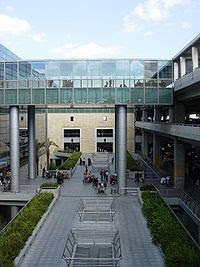
Terminal 3, which opened on 28 October 2004, replaced Terminal 1 as the main international gateway to and from Israel. The building was designed by Skidmore, Owings and Merrill (SOM). Moshe Safdie & Associates and TRA (now Black and Veatch) designed a linking structure and the airside departure areas and gates. Ram Karmi and other Israeli architects were the local architects of record. The inaugural flight was an El Al flight to John F. Kennedy International Airport in New York City.
The new terminal was built to serve over 10 million passengers per year. It could accommodate 16 million passengers a year with the addition of two concourses to the existing three. One additional concourse is currently in the planning stages, along with an expansion of the landside terminal. Due to the proximity of the airport to the country's largest population centres and the problem of noise pollution, another international airport is being considered to be built elsewhere in the country.
Work on Natbag 2000, as the Terminal 3 project was known, was scheduled for completion prior to 2000 in order to handle a massive influx of pilgrims expected for the Millennium celebrations. This deadline was not met due to higher than anticipated costs and a series of work stoppages in the wake of the bankruptcy of the main Turkish contractor. The project eventually cost an estimated one billion US dollars.
Terminal 3 uses the Jetway system. The overall layout is similar to that of airports in Europe and North America, with multiple levels and considerable distances to walk after disembarking from the aircraft. The walk is assisted by escalators and moving walkways. The ground floor departures hall, with an area of over 10,000 square metres (107,639 sq ft), is equipped with 110 check-in counters and as well as Flight information display systems. A small shopping mall, known as Buy & Bye, is open to both travellers and the general public. The mall, which includes shops, restaurants and a post office, was planned to be a draw for non-flyers too. On the same level as the mall, passengers enter passport control and the security check. Planes taking off and landing can be viewed from a distinctive tilted glass wall. Car rental counters are located in an intermediate level situated between the departing and arriving passenger halls. Terminal 3 has two synagogues.
After the main security check, passengers wait for their flights in the star-shaped duty-free rotunda. A variety of cafes, restaurants and duty-free shops are located there, open 24 hours a day, as well as a synagogue, banking facilities, a transit hall for connecting passengers and a desk for VAT refunds.
Terminal 3 has a total of 30 gates divided among three concourses (B, C and D), each with 8 jetway-equipped gates (numbered 2 through 9) and 2 stand gates (bus bays, 1 and 1A) from which passengers are ferried to the aircraft. Almost all El Al flights utilize concourse D with other airlines using concourses B and C. Room exists for two additional concourses (A and E). Currently, the addition of concourse E is in the planning stages along with an expansion of the landside terminal.
Free wireless internet is provided throughout the terminal. The terminal has three business lounges - the exclusive El Al King David Lounge for frequent flyers and two 'Dan' lounges for either privileged or paying flyers. In January 2007, the IAA announced plans for a 120-bed hotel at Terminal 3.
This terminal, built in 1999, was meant to handle the crowds expected in 2000, but never officially opened. To date, it has only been used as a terminal for passengers arriving from Asia during the SARS epidemic.Another use for the terminal was for the memorial ceremonies upon the arrival of the casket of Col. Ilan Ramon after the Columbia disaster in February 2003 and the arrival of Elchanan Tenenbaum and the caskets of 3 Israeli soldiers from Lebanon in January 2004.
The closest runway to terminals 1 and 3 is 12/30, 3,112 meters (10,210 feet) in length, and is followed by a taxiway. Most landings take place on this runway from West to East, approaching from the Mediterranean Sea over southern Tel Aviv. During inclement weather, it may also be used for takeoffs (Direction 12). A 17 million NIS renovation project was completed in November 2007 which reinforced the runway and made it suitable for future wide-body aircraft such as the new Airbus A380. In September 2008, a new ILS serving the runway was activated.
In the past, the short runway, (direction 03/21), 1,780 meters (5,840 feet) in length, mainly served cargo aircraft of the Israeli Air Force. Today it functions mostly as a taxiway for the quiet runway. Rarely, it is used for landing from north to south (Direction 21). By the middle of the decade however, the IAF facilities adjacent to the short runway are slated to be relocated to Nevatim and the runway will be lengthened to over 9,100 feet (2,800 m), equipped with an ILS, and placed into full commercial usage.
The longest runway at the airfield, 3,657 meters (11,998 feet), and the main take off runway from east to west (Direction 08/26), referred to as "the quiet runway" since jets taking off in this direction produce less noise pollution for surrounding residents. This is the newest runway in the airport, built in the early 1970s. A 24 million NIS renovation project completed in February 2006 reinforced the runway and made it suitable for future wide-body aircraft such as the new Airbus A380.
The fact that the main runway and the quiet runway intersect near their western ends often creates a crisscross pattern between aircraft landing and taking off. This pattern reduces the amount of air traffic which can circulate in and out of the airport and has detrimental safety implications as well. To alleviate these issues, extensive works began in 2010 to construct new taxiways and lengthen the short and quiet runways. When all phases of construction are completed, runway 03/21 will become the main landing runway (usually heading from north to south), instead of runway 12/30 which will then be used on a secondary basis only. Most take offs will continue to take place from the quiet runway heading west. This configuration will enable a new approach pattern to and from the field, allowing simultaneous takeoffs and landings at most times of the day and more than double the number of aircraft movements which can be handled at peak times while increasing the level of air safety in and around the airport. The project will cost nearly 1 billion NIS and is scheduled to be completed by early 2014.
The plane of Roman Abramovitch landing at Ben Gurion
Ben Gurion International Airport is one of the world's most secured airports. Security operates on several levels.
All cars, taxis, buses and trucks go through a preliminary security checkpoint before entering the airport compound. Armed guards spot-check the vehicles by looking into cars, taxis and boarding buses, exchanging a few words with the driver and passengers. Armed security personnel stationed at the terminal entrances keep a close watch on those who enter the buildings. If someone arouses their suspicion or looks nervous, they may strike up a conversation to further assess the person's intent. Plainclothes armed personnel patrol the area outside the building, and hidden surveillance cameras operate at all times.Inside the building, both uniformed and plainclothes security officers are on constant patrol. Departing passengers are personally questioned by security agents even before arriving at the check-in desk. This interview can last as little as a minute, or as long as an hour if a passenger is selected for additional screening. Luggage and body searches may be conducted. After the search, bags are placed through an X-ray machine before passengers proceed to the check-in counters. Occasionally, if security have assessed a person as a low risk, they will pass them straight through to the check-in desks, bypassing the main x-ray machines.
Until August 2007 there was a system of color codes on checked luggage but the practice was discontinued after complaints of discrimination.
The IAA is planning a major upgrade of checked baggage screening process in late 2011 whereby the screening of checked baggage will be performed "behind the scenes" after passenger baggage has been checked in (as is the practice in most airports). To that end, the IAA selected French company Safran to supply the most advanced x-ray/CT scanning machines currently available. The current pre-check in baggage screening processes is at times a source of complaints from travelers, particularly foreigners and minorities who are often subjected to more stringent screenings; the envisioned process aims to make the check-in process quicker and more passenger-friendly as well as more secure since 100% of checked baggage will undergo screening, including baggage from passengers deemed to be low-risk who are currently sometimes allowed to proceed to check in without having their baggage x-rayed.
After check-in, checked baggage is put in a pressure chamber to trigger any possible explosive devices. Passengers continue through to personal security and passport control, as in other airports. Before passing through the metal detectors and placing carry-on baggage through the X-ray machine at the security checkpoint, passports and boarding passes are re-inspected and additional questions may be asked. Before boarding the aircraft, passports and boarding passes are verified once again. Security procedures for incoming flights are not as stringent, but passengers may be questioned by passport control depending on country of origin, or countries visited prior to arrival in Israel. Passengers who have recently visited countries at war with Israel (all Arab countries except Bahrain, Egypt, Jordan, Mauritania and Qatar) may be subject to further questioning.
In December 2006, Ben Gurion International Airport ranked first among 40 European airports and 8th out of 77 airports in the world, in a survey, conducted by Airports Council International, to determine the most customer-friendly airport. Tel Aviv placed second in the grouping of airports which carry between 5 and 15 million passengers per year behind Japan's Nagoya Airport. The survey consisted of 34 questions. A random sampling of 350 passengers at the departure gate were asked how satisfied they were with the service, infrastructure and facilities. Ben Gurion received a rating of 3.94 out of 5, followed by Vienna, Munich, Amsterdam, Brussels, Zurich, Copenhagen and Helsinki. The airport retained its title as the best Middle Eastern airport in the 2007 and 2008 surveys.
The airport's busiest year was 2010: Over 11.9 million passengers passed through the airport (an increase of 9.4% over the previous year) on above 98,000 commercial operations. In 2006, the largest airlines on international routes were: El Al (40.6% of flights), Lufthansa (4.16%), Continental Airlines (3.96%), Israir (3.85%) and Arkia (3.83%). A steep rise in the number of domestic passengers using the airport is expected in the future in the wake of plans to close down Sde Dov Airport (which currently handles considerably more domestic passengers annually than TLV) and build luxury towers on the Sde Dov property. All commercial flights will be rerouted to Ben Gurion.
The 2009 recession hit TLV as well. Half a million less passengers passed through the airport in 2009. The hardest hit were the domestic carriers which saw 35.6% passengers less than 2008. Internationally speaking, TLV saw 1.1% less passengers than in the previous year.
Traffic volume recovered considerably in 2010 however, rising about 9.4% in the January—December timeframe as compared to the same period in 2009, what made 2010 the busiest year in the airport's history. In addition, August 2010 was recorded as the busiest month in the history of the airport with up to 1,480,000 international passengers who flew and landed in the airport.
The airport is located near Highway 1, the main Jerusalem-Tel Aviv Highway and Highway 40. The airport is accessible by car or public bus. Israel Railways operates train service to and from the airport to several parts of the country and taxi stands are located outside the arrivals building. A popular transportation option is a share taxi van, known in Hebrew as a "monit sherut", going to Beer Sheva, Haifa and Jerusalem.
Israel Railways operates the Ben Gurion Airport Railway Station, located in the lower level of Terminal 3. From this station passengers may head north-west to Tel Aviv, Haifa and other destinations in the north, or south-east to Modi'in.The journey to Tel Aviv Savidor Central Railway Station takes about 18 minutes. Almost 3.3 million passengers used the railway line to and from the airport in 2009. The line to Modi'in is part of a new rail line under construction from Tel Aviv to Jerusalem which is scheduled for completion in 2016. The service does not operate on Shabbat and Jewish holidays. The line to Nahariya through Tel Aviv and Haifa runs 24 hours a day.
The airport is served by regular inter-city bus lines, limousine and private shuttle services, Sherut "shared" door to door taxi vans and standard taxis. An Egged #5 shuttle bus ferries passengers between the terminals and a small bus terminal in the nearby Airport City industrial/office park where they can connect to regular Egged bus routes passing through the area. Passengers connecting at Airport City can pay for both rides on the same ticket, not having to pay an extra fare for bus #5. Other bus companies directly serve Terminal 3, and the airport also provides a free shuttle bus between terminals.


